Thursday, 5 November 2020

International Webinar by IIT Kharagpur on Indian Knowledge Systems to Explore Revival of Indian Scientific Heritage Studies in Technical Institutes


International Webinar by IIT Kharagpur on Indian Knowledge Systems to Explore Revival of Indian Scientific Heritage Studies in Technical Institutes


Biswabrata Goswami

Hummingbird News

KHARAGPUR, 4 NOV: IIT Kharagpur is organizing an international webinar on Indian Knowledge Systems from November 6-8, 2020. Titled BharataTirtha after Gurudev Rabindranath Tagore poem, the webinar aims to trace the philosophical and scientific heritage of India and make progress towards the future of Indology and its application to the contemporary human world in correlation with the physical, economic, environmental, and social sphere of human life.

The webinar shall be commensurate with India’s current National Education Policy (NEP) to best position India’s scientific heritage within the ambit of the pursuit of advanced science and technology.

It will witness talks by international stalwarts pioneering in Indic studies including Arthashastra (Economics), Sanskrit for Natural Language Processing, Vedic and Ancient Indian Mathematics - Numeral System, Bijaganita and Jyamiti, Rasayana (Chemical Sciences), Ayurveda (Biological Sciences), Jyotir-tathaMahajagatikaVidya (Positional and Astronomical Sciences), PrakritiVidya (Terrestrial/ Material Sciences/ Ecology and Atmospheric Sciences) and NandanaTathyatathaVastuVidya (Archaeology, Iconography and Architecture).

Shri Ramesh PokhriyalNishank, Hon’ble ShikshaMantri will be present as the Chief Guest. He will be joined by Shri Sanjay Dhotre, Hon’ble MoS, Education Ministry and Shri Amit Khare, Secretary Higher Education, Govt. of India, as the guests of honour.

Talking about the way forward for the IITs in the subject area of Indian Knowledge Systems, Director, IIT Kharagpur Prof. Virendra K Tewari remarked on the need to create and promote an Independent Center of Indian Knowledge Systems to revive the interest of students and faculty in Indian heritage and recreate a comprehensive and positive atmosphere of research, and outreach to humanity as a whole. “The webinar which shall be the first among a long series of subsequent ones will create a comprehensive knowledge base and further promote an international policy of Indology. This is in the lines of the several firsts we have achieved in various scientific and technological progress of our nation which has led to us becoming an Institute of Eminence,” he said.

The speakers include Shri Sanjeev Sanyal, Principal Economic Advisor, Govt. of India and Dr. Deepa Sankar, Chief of Education, UNICEF, Uzbekistan (Europe and Central Asia Region) on Arthashastra, Prof. Gérard Huet, National Institute for Research in Computer Science and Automation, France and Prof. Amba Kulkarni, Department of Sanskrit Studies, University of Hyderabad on Sanskrit for Natural Language Processing, Prof. Clemency Montelle, University of Canterbury, New Zealand and Prof. K. Ramasubramanian, IIT Bombay on Vedic and Ancient Indian Mathematics, Prof. B. M. Deb, Visva-Bharati, Santiniketan and Prof. Samaresh Bhattacharya, Jadavpur University, Kolkata on Bharatiya Rasayan, Dr. P. Rammanohar, Amrita Vishwa Vidyapeetham, Coimbatore and Dr. MitaliMukerji, Institute of Genomics and Integrative Biology, New Delhi on Ayurveda, Prof. Mayank N. Vahia, Tata Institute of Fundamental Research, Mumbai and Prof. Amitabha Ghosh, Former Director, IIT Kharagpur on Positional and Astronomical Sciences, Prof. Arunendu Banerjee, Visva-bharati, Santiniketan and RabindraBharati University and Prof. OmkarnathMohanty, IIT Bhubaneswar on Terrestrial/ Material Ecology and Atmospheric Sciences, Dr. Shikha Jain, Director, The DRONAH Foundation, Gurgaon and Dr. RajraniKalra, Urban and Regional Geography Expert, California State University, San Bernardino, USA on Archaeology, Iconography and Architecture. Among the other experts are Prof. M. D. Srinivas, Chairman, Center for Policy Studies, Chennai, as the keynote speaker, Prof. Anil D. Sahasrabudhe, Chairman, AICTE and Prof. Shishir K. Dube, Former Director, IIT Kharagpur as panelists for the session on ‘WAY FORWARD for IITs in Indian Knowledge Systems’. They will be joined by faculty experts from various disciplines at IIT Kharagpur.

The organizing members include Prof. Virendra Kumar Tewari, Director, IIT Kharagpur (chief patron), Prof. S.K. Bhattacharya, Deputy Director, IIT Kharagpur (patron), Prof. Somesh Kumar, Dean of Students’ Affairs, IIT Kharagpur (chairman), Prof. Joy Sen, Department of Architecture and Regional Planning, IIT Kharagpur (organizing secretary), Prof. Anuradha Choudry, Department of Humanities and Social Sciences, IIT Kharagpur (joint secretary).

Monday, 2 November 2020

China deploys H-6 bombers along LAC


China deploys H-6 bombers along LAC


The H-6’s considerable firepower, deploying a wide range of standoff cruise missiles, can potentially provide the PLA with a major advantage in the event of a future clash in the Ladakh region, the report stated. 


By Soma Mookherjee

City Editor, The Statesman

KOLKATA, 1 NOV: China appears to be sticking with its “Wolf Warrior” tactics of intimidation amid simmering tensions with India on its Himalayan border. According to Military Watch Magazine, new images released by the Central Theatre Command of the Chinese People’s Liberation Army (PLA) show several H-6 bombers have been deployed near the disputed Line of Control (LOC).

China deploys over 270 H-6 bombers across the country, the bulk of them based near its east coast, which make up the largest bomber fleet in the world with much newer airframes available than those in the American or Russian fleets, said Grp Captain (rtd) R K Das.

The H-6’s considerable firepower, deploying a wide range of standoff cruise missiles, can potentially provide the PLA with a major advantage in the event of a future clash in the Ladakh region, the report stated. 

Given the scarcity of airbases on both sides, the ability to strike Indian bases at long ranges could be enough to turn the balance in the air.

Most notably, the new CJ-20 cruise missile carries a 500kg warhead and has a 2,000 km range, while its lighter counterpart the YJ-63 has one tenth of the range but is considerably lighter, meaning more can be carried by a single bomber, the report stated.

Their very high precision and manoeuvrability make them a very serious threat to Indian positions, Grp Captain added.

He said, "tensions with India, however reveal that the aircraft still have a role to play in a conventional land attack role, the report said. China has over 270 H-6 bombers across the country, the bulk of them based near east coast. India on the other hand, was reportedly considering acquiring modern bombers from Russia, namely the Tu-22M, to serve as a maritime strike platform. 

It currently deploys  air superiority fighters which have a formidable range estimated at 300-400 km — with the missiles well optimized in engaging subsonic bombers, the report said. India has ordered S400 Air Defense Missile system which will be deployed to the Ladakh region when they are received from Russia, with the platforms highly capable at intercepting cruise missile attacks as well as bombers at long ranges.

Courtesy: Images from Web/ China Military

Sunday, 1 November 2020

Durgapur barrage lock gate breaks once again after 2017, leads to panic among locals


Durgapur barrage lock gate breaks once again after 2017, leads to panic among locals 


"We are expecting to help complete restoration in next couple of days. Work is in progress on war footing," said Sanjay Singh, Executive Engineer of the Damodar Headworks Division of the State Irrigation Department.


Rasida Kazi

Hummingbird News

DURGAPUR, 31 OCT: In just three years, the Durgapur Barrage on the Damodar faced yet another disaster after another lock gate of the 692 metres Barrage collapsed in the wee hours today.

On 24 November, 2017, the Gate No:1 of the Barrage had broken and today it was the turn of Gate No: 31 that jeopardized the civic life, cultivation and also hit the machines at the vital utilities like power and steel perpendicularly on the right and left banks of the Damodar. "If the situation persists, our generation would see a grinding halt in 48 hours," said Nikhil Chowdhury, Chief Engineer, Mejia Thermal Power Station - the largest power utility in eastern India.

"We are expecting to help complete restoration in next couple of days. Work is in progress on war footing," said Sanjay Singh, Executive Engineer of the Damodar Headworks Division of the State Irrigation Department.

At 4:30 am today, the local fishermen heard a crushing noise and awfully witnessed a desperate uncalled for deluge gushing in close to the right bank and that started attracting their small boats too. Somehow managed to escape, the scared fishermen sent SOS to the local Barrage officer who rushed to press the panic button.

"Almost 40 inches of the sluice Gate No: 31 showed a sharp bent in its lower left blade pricking the pond reservoir to get spilled through," said Singh.

It took almost six hours to decide whether the entire 8000 acre-feet water reserve of the Barrage needed to be exhausted and at 11 am, the entire 34 lock-gates of the Barrage were opened moderately to help the discharge rate at a meagre 700 cusecs keeping in mind whether the discharge would injure crop in the districts like East Burdwan, Bankura, Hooghly and Howrah in the lower Damodar region.

At 4 pm, the entire Barrage pond was drained out. A team of mechanical engineers then took the measurements of the damaged portion and the officials decided to replace the Gate.

A new gate kept in custody of the Damodar Headworks Division meanwhile mismatched with the Gate No: 31 as it was of Under Sluice type against the requirement of a Weir Proper type gate.

"Let’s install this and then we would customize it over night with additional fittings," ordered Jayanta Das, Chief Engineer (West) of the Irrigation Department at 7 pm today.

'Multidisciplinary education will be the central point to lead India into 21st century'


'Multidisciplinary education will be the central point to lead India into 21st century'


“I still remember the events in ISRO related to the failures of the first two Augmented Satellite Launch Vehicles (ASLVs). Even though a sense of despondency overtook us initially, we did not allow the setback to override our resolve to succeed,” Dr Kasturirangan said.


Biswabrata Goswami

Hummingbird News

KRISHNAGAR, 31 OCT: Multidisciplinary education will be the central and crucial point to lead India into the 21st century and the fourth industrial revolution, said K. Kasturirangan, Chairman, Drafting Committee, National Education Policy 2020.

Kasturirangan, the former Chairman of Indian Space Research Organisation (ISRO), is currently serving as the Chancellor of the Central University of Rajasthan, and as the Chairperson of NIIT University.

He was speaking at the virtual convocation address of the Indian Institute of Information Technology, Design & Manufacturing (IIITDM), in Kancheerpuam.

“As a crucial step to lead India into the 21st century and the fourth industrial revolution, multidisciplinary education is central. Engineering schools, such as the IITs and even your institution, will move towards more holistic multidisciplinary education with more arts and humanities, while arts and humanities students will aim to learn more science. All will make an effort to incorporate more vocational subjects and soft skills,” Kasturirangan said.

He said IIITDM with its plans for bringing multidisciplinarity and holisticity to its various courses could be in the forefront of creating world-class innovators and producing seminal ideas coming out of a thinking process that cuts across disciplines by marrying science education with arts and humanities and other fields.

Dr Kasturirangan said, “The vision of India’s new educational system has been crafted to ensure that it touches the life of each and every citizen consistent with their needs and necessities besides creating a just and equitable society. The approach is to realize a new system aligned with aspirational goals of 21st century education while remaining rooted to India’s value systems and ethos. The policy provides an integrated, yet flexible approach to education.

"The approach is to realise a new system aligned with the aspirational goals of 21st century education while remaining rooted to India's value systems and ethos. The policy provides an integrated, yet flexible approach to education," he said.

According to him, the new education policy has kept the interconnectedness of the various phases of education in mind and how the same will enable continuity, coherence and processes to ultimately realise an end-to-end educational roadmap for the country.

"Major emphasis is given in the policy to the aspect of holistic, multidisciplinary education as a foundational component at all levels of education," he added.

Delving on the higher educational system in the new education policy, Kasturirangan said the holistic nature of education, also called liberal education in contemporary discussions, traces its origin to the age-old idea of liberal arts discussed almost 1400 years ago in the classical Indian texts on education like Banabhatta's 'Kadambari', wherein a truly educated person is described as one who had mastered all the 64 kalas - a composite of a number of multidisciplinary subjects.

The former ISRO Chairman advised the fresh graduates to have conviction in whatever they do and cited his experience at the space agency.

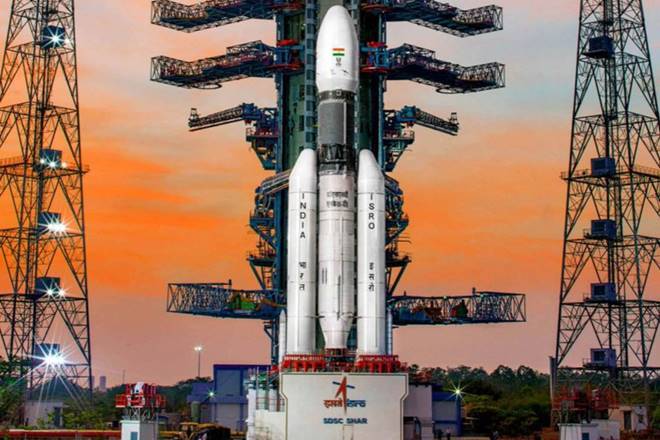
“I still remember the events in ISRO related to the failures of the first two Augmented Satellite Launch Vehicles (ASLVs). Even though a sense of despondency overtook us initially, we did not allow the setback to override our resolve to succeed,” he said.

According to him, the critical analysis and the in-depth assessment of the problems and the technology and quality issues that were addressed really paved the way for the success of the present generation of Polar Satellite Launch Vehicles (PSLVs) and the Geosynchronous Satellite Launch Vehicles (GSLVs).

“In analysing the failures, we got an insight into the inadequacies and the marginal nature of our initial design. Further, our courage of conviction made us work with renewed vigour to succeed, which we did. I have often felt that life can teach you more from a failure than through success,” Dr Kasturirangan said.

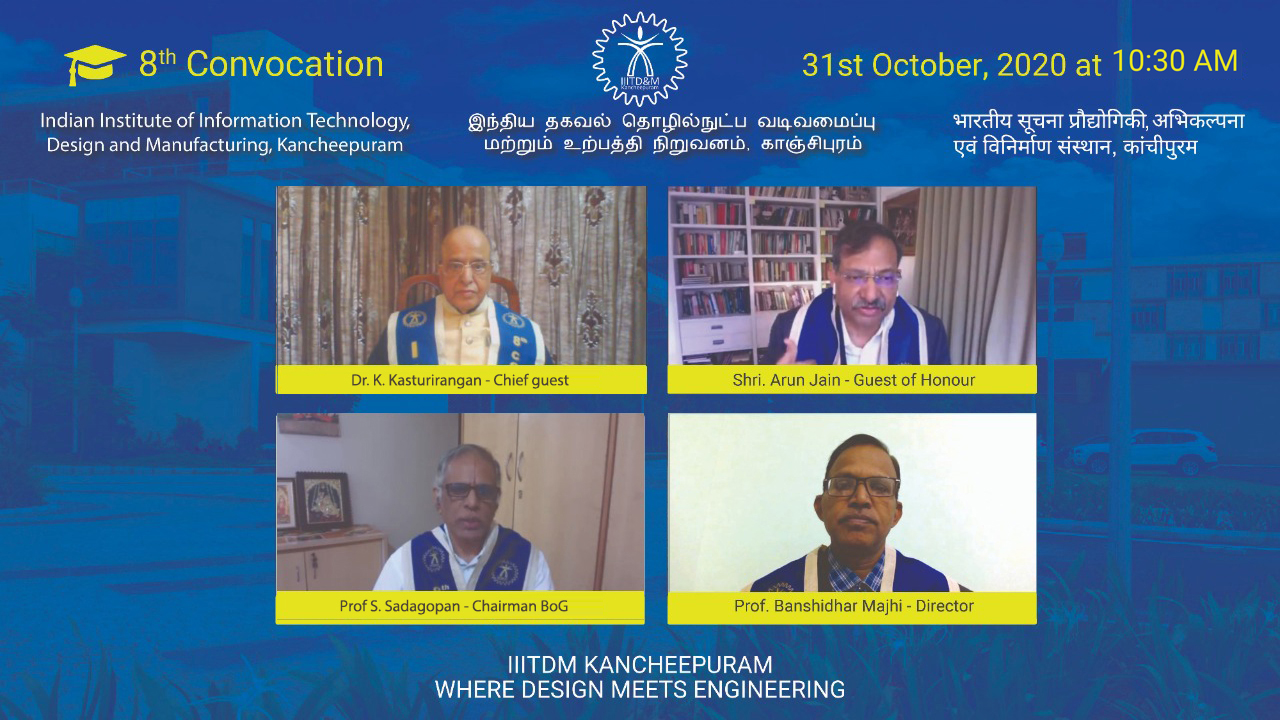
A total of 306 students graduated during the eighth Convocation of Indian Institute of Information Technology, Design and Manufacturing - Kancheepuram held virtually today (31st October 2020). It is an ‘Institute of National Importance’ coming under the Ministry of Education, Government of India, and located near Chennai, Tamil Nadu.

For the Current Academic Year of 2020-21, the Institute launched three new M.Tech. programs in Advance Robotics, Power Electronics System Design and Computer Science and Engineering to empower the young engineers of India with specialized skill sets and to face the technological challenge of the future. Information Technology (IT) drives both undergraduate and postgraduate education in the Institute with focus on Design and Manufacturing as two major verticals.

The Degrees were awarded virtually in the presence of Dr. K. Kasturirangan, Chairman, National Education Policy (NEP) 2020 Committee, who was the Chief Guest, Shri. Arun Jain, Chairman and Managing Director, Intellect Design Arena, Chennai, the Guest of Honour, Prof. S Sadagopan Chairman, Board of Governors, IIITDM Kancheepuram, Prof. Banshidhar Majhi, Director, IIITDM Kancheepuram, faculty and staff of the Institute.

Addressing the Students, Prof. S Sadagopan Chairman, Board of Governors, IIITDM Kancheepuram, said, “The year 2020 will go down in history as a very special year when the world witnessed the Covid-19 pandemic causing enormous difficulty to millions of our brothers and sisters. Practically, everyone on this planet has been impacted by COVID-19. IIITDM students and faculty are no exception. You all had to stay home for nearly half of your last Semester and face lots of difficulties particularly by the less-endowed students and those who had limited access. It must have been equally challenging for many of your faculty members who had to adapt to new forms of teaching. Together, the students and the teachers could complete your studies without compromising on quality, thanks to technology!”

Prof. Banshidhar Majhi, Director, IIITDM Kancheepuram, said, “IIITDM Kancheepuram was established in the year 2007 by the Ministry of Education, Government of India, with a specific mandate to excel in IT, and IT-enabled Design and Manufacturing-focused education and research. In the present Convocation, Degrees will be awarded to 306 students, out of which 146 degrees are B. Tech., 112 are Dual Degrees, 41 are M.Tech., 2 are M.Des. and 5 Ph.Ds. Apart from this, institute medals will be conferred in various categories. The institute follows an inter-disciplinary curriculum and CBCS from its inception with thrust on ‘Design Thinking’ and ‘Product Development’.”

Wednesday, 28 October 2020

IIT Guwahati develops low-cost technology to produce psychoactive drugs and anti-aging compounds from agricultural resources


IIT Guwahati develops low-cost technology to produce psychoactive drugs and anti-aging compounds from agricultural resources


The low-cost technology is patented and developed by Prof. Mihir Kumar Purkait, Head, Centre for the Environment, and Professor, Department of Chemical Engineering along with his M Tech student Mr V L Dhadge


Biswabrata Goswami

Hummingbird News 

KRISHNAGAR, 28 OCT: Indian Institute of Technology (IIT) - Guwahati researcher has developed a low-cost membrane technology to produce psychoactive drugs and anti-aging compounds from wide range of agricultural resources like camellia sinensis, citrus fruits and peels especially orange peels, berries, ginkgo biloba, parsley, pulses, tea, sea buckthorn and onions.

The technology is patented and developed by Prof. Mihir Kumar Purkait, Head, Centre for the Environment and Professor, Department of Chemical Engineering, IIT Guwahati along with his M Tech student Mr V L Dhadge. 

The low-cost technology doesn’t use any organic solvents. The health-related benefits of psychoactive drugs (caffeine) and anti-aging compounds (flavonoids) attributed to stimulating detoxification of enzyme activity and inhibition of cell invasion and angiogenesis. Because of medicinal applications, flavonoid components have gained popularity as ingredients in pharmaceutical industry. These are also found in smaller amount in bamboo leaves, grapes, apples, and other natural sources. 

While explaining the process about how the technology works, Prof. Mihir Kumar Purkait, said, “The developed technology is exclusively pore/particle size based pressure driven membrane separation process. The water extracts of above mentioned plants/fruits/leaves at optimum operating conditions are passed through a specially made cascade membrane units of fabricated with appropriate molecular weight cut off (MWCO) membranes capable of separating targeted flavonoids selectively. Permeate and retentive part from appropriate membrane unit is then fridge dried to get the powdered product. We have synthesized stimuli responsive smart membrane for the selective separation and purification of targeted compound from the mixture of plants or leaves or fruits extract in simple water”.

The commercially available techniques are using various costly organic solvents like: Chloroform, Acetone, Acetonitrile etc. As a result the prices of these important pharmaceutical raw materials are quite high that ultimately increases the price of the antioxidant. Since organic solvents are used, the technology suffers various disadvantages like: low product quality and yield, high operating and product cost, more time consuming and high energy intensive process for solvent recovery and has limitation to run continuation mode in industrial scale.


Camellia Sinensis

The technology developed by Prof. M K Purkait doesn’t require any costly organic solvents and uses only water. Hence, the cost of the process and price of pharmaceuticals thereon is much cheaper than that of existing solvent based separation technique. The patented membrane based green technology has enormous scope to replace existing costly organic solvent based techniques and can be used for continuation mode of operation in industrial scale.

India is the largest consumer (20% of the global production) and second largest producer of camellia sinensis. Worldwide, there are very few manufacturers of flavonoids produced using solvent based technique having less purity (40-80%) and high price. It has been estimated that the global market for flavonoids is expected to reach about 412.4 MT by 2022 from 347.8 MT in 2017 reported in the Ministry of Commerce, Government of India’s Import-Export current statistics. The developed technology will support “Make in India” initiative of the Government of India by producing these compounds in the country. This will definitely reduce the import of said polyphenolic compounds. Implementation of the said technology will also create job opportunities in agriculture sector of the country.

Now, any Indian citizen can buy land in Jammu & Kashmir


Now, any Indian citizen can buy land in Jammu & Kashmir


Unacceptable amendments to the land ownership laws of J&K. Even the tokenism of domicile has been done away with when purchasing non-agricultural land & transfer of agricultural land has been made easier. J&K is now up for sale & the poorer small land holding owners will suffer.


Biswabrata Goswami 

Hummingbird News

KRISHNAGAR, 27 OCT: In a significant move, the Center has paved the way for people from outside Jammu and Kashmir to buy land in the Union Territory (UT) by amending several laws.

The Union home ministry said in an order that the Real Estate (Regulation & Development) Act, 2016 has been notified in the UT while 12 laws of the erstwhile state have been repealed.

The Act makes it mandatory for each state and UT to set up its own real estate regulator and frame rules to govern the functioning of the regulator. In a gazette notification, the Centre omitted the phrase “permanent resident of the state” from Section 17 of the Jammu and Kashmir Development Act, which deals with disposal of the land in the UT.

“With immediate effect, the Acts mentioned in the schedule to this order shall, until repealed or amended by a competent legislature or other competent authority, have an effect, subject to the adaptations and modifications directed by the said schedule, or if it is so directed, shall stand repealed,” said the order.


On August 5 last year, the Centre had abrogated Article 370 of the Constitution which granted special status to the erstwhile state, bifurcating it into UTs of J&K and Ladakh. Earlier, Article 35A prohibited citizens from other parts of India from buying land in J&K. It allowed the J&K legislature to define permanent residents of the state and only those who were eligible could purchase land or property.

As per section 96 of the J&K Reorganisation Act, 2019, the Centre has the powers to repeal or amend the laws for the application of any law made before the appointed date till the expiration of one year from the appointed date in relation to Union Territories.

Earlier, the laws passed by Parliament were applicable to the state only after the state government gave its concurrence due to its special status and separate Constitution. The J&K Reorganisation Act, 2019, extended 113 central laws including Muslim Women Protection of Rights Act, 1986, RTI Act, PC Act, Aadhaar Act, Enemy Property Act, Evidence Act, Special Marriage Act, Delimitation Act and Dissolution of Muslim Marriage Act to J&K. A total of 165 laws exclusively framed for the state of Jammu and Kashmir were repealed.


Political parties here called it unacceptable saying it was like putting J&K up for sale.

However, the government like previous orders, has not extended the adaptation to Ladakh region. A senior government official said the third adaptation of the laws is only meant for Jammu and Kashmir, not Ladakh.

“Unacceptable amendments to the land ownership laws of J&K. Even the tokenism of domicile has been done away with when purchasing non-agricultural land and transfer of agricultural land has been made easier. J&K is now up for sale and the poorer small land holding owners will suffer,” former chief minister Omar Abdullah said.

Unacceptable amendments to the land ownership laws of J&K. Even the tokenism of domicile has been done away with when purchasing non-agricultural land & transfer of agricultural land has been made easier. J&K is now up for sale & the poorer small land holding owners will suffer.


In another order issued on Tuesday, the Union home ministry repealed and amended 25 other central laws including the Stamp Act, 1977, Jammu and Kashmir Civil Services Decentralisation and Recruitment Act.

Further amending the J&K Development Act, 1970, the order said, the government might on the written request of an Army officer not below the rank of Corp commander, can declare an area as “strategic area” within a local area “only for direct operational and training requirement of armed forces”.

By amending the J&K Agrarian Reforms Act, 1970 the MHA has also clipped the powers of the Revenue Minister, who citing public interest “could overturn” an order passed by a Tehsildar or Assistant Commissioner in respect of any evacuees land or state land. It is to be noted here that J&K is currently under the Central rule.

In this order, the MHA has further amended the domicile law by allowing “spouse of a domicile” to be deemed a domicile. This was earlier applied only to children of Central government officials posted in J&K for a total period of 10 years, who are also eligible as domiciles.

Under the order, a new body - the J&K Industrial Development Co-operation - has been set up and if it is unable to acquire land, the government could invoke the provision of the Right to Fair Compensation Act, and acquire the land on behalf of the corporation for public purposes.

With the changes in the land acts, the MHA said, “The Real Estate (Regulation and Development) Act (RERA), 2016 will now be applicable in the UT.”

The erstwhile state laws, which are completely repealed, include the Jammu & Kashmir Alienation of Land Act, the Jammu & Kashmir Big Landed Estates Abolition Act, the Jammu & Kashmir Common Lands (Regulation) ACT, 1956, the Jammu & Kashmir Consolidation of Holdings Act, 1962, and a few others.

Courtesy: Images from Web.

Monday, 26 October 2020

The cause of racism, bigotry and fundamentalism is sheer ignorance : David J Gross, Nobel laureate says in IIT-Madras virtual convocation


The cause of racism, bigotry and fundamentalism is sheer ignorance : David J Gross, Nobel laureate says in IIT-Madras virtual convocation 


“Life is not made up of years but of moments. As we look back on our life, what we remember is a collection of moments. None of us remember our beginning and none of us will remember our end. This moment is both a beginning and an ending for you," Prof. Gross


Biswabrata Goswami  

Hummingbird News      

KRISHNAGAR, 25 OCT: Drawing attention to racism, bigotry and fundamentalism, theoretical physicist David J Gross who won the Nobel prize in physics in 2004 said on Sunday that the cause of many of these problems is sheer ignorance.

While speaking at the 57th convocation of IIT-Madras held virtually from Santa Barbara, US, Prof Gross said, “The ignorance of basic facts such as that we all of us had a single mother only a few thousand generations ago that make racism and bigotry still possible. The ignorance of other cultures that promotes radical nationalism”.

Prof. David J Gross, Nobel Laureate and Chancellor’s Chair of Theoretical Physics, University of California, graced the occasion as Chief Guest. Dr. Pawan Goenka, Chairman, Board of Governors, IIT Madras and Managing Director, Mahindra and Mahindra, presided over the Convocation.

Prof Gross pointed out that the graduating students have the responsibility to be the forces of enlightenment and asked them to strive to dispel the ignorance.

“The reason that fundamentalists are so dangerous is not that they are so dangerous, but they are so certain that they possess the absolute truth. It is this certainty that can lead to oppression, bidotry, racism and fanaticism. The main lessons of science are not partial truths that we labour to reveal. But, an attitude of scepticism towards these truths. We must always remain sceptical, always question our beliefs and confront them with nature” he told the graduating students.

Prof Gross further said, “Many of you are completing your education today and are now wondering what the next few years will bring. One thing I am sure of is that no one can give you any answer. The world is undergoing rapid change and as the event of the last few months show, no one can predict what will happen next week, much less beyond that. The same is true of science and one’s career in science.”

On Covid-19 pandemic, he said many scientists predicted that such a pandemic would inevitably arrive and yet their warnings were largely ignored.

“Similarly, many scientists warn of impending disasters of global warming, climate change. Yet, these warnings have not been sufficiently addressed. I take this occasion to warn all of the continuing and indeed worsening danger of nuclear weapons whose use could destroy all life on the planet. We must not ignore it”, he said.

Prof Gross said, “Life is not made up of years but of moments. As we look back on our life, what we remember is a collection of moments. None of us remember our beginning and none of us will remember our end. This moment is both a beginning and an ending for you. For many of you, it is the end of college tuition and the beginning of repayment of student loans. For many of you, it is the end of the process in which you absorbed vast knowledge and the beginning of the process when you begin to apply that knowledge or pass it along to the next generation. For many of you, it is the end of formal education and the beginning of the so-called ‘real life’.”

“For many of you, it is the end of the period in life where you received from your parents and society and the beginning of the period where you give back to the society. And there is much that you can give back, for you are a privileged lot. Privileged to be citizens of a rapidly-growing country with a rich and glorious history that is now moving on to take its rightful place in the world. You are fortunate to be free of disease, hunger and war that plagued much of humanity for most of the times. You are privileged to have attended a great institution of learning and to have acquired much knowledge,” said Prof. David J Gross.

Prof. David Gross was awarded the 2004 Nobel Prize in Physics along with H. David Politzer and Frank Wilczek for the discovery of asymptotic freedom in the theory of the strong interaction. He has been a central figure in particle physics and string theory. His discovery, with his student Frank Wilczek, of asymptotic freedom—the primary feature of non-Abelian gauge theories—led Gross and Wilczek to the formulation of Quantum Chromodynamics, the theory of the strong nuclear force.

Speaking on the occasion, Dr. Pawan Goenka, Chairman, Board of Governors, IIT Madras, remarked, “Class of 2020 - you have a very special distinction. The distinction of graduating from an institute, which has been ranked the #1 Engineering College in India, for five years in a row. Further, IIT Madras also continued to hold on to the No.1 position in the Atal Ranking of Institutions on Innovation Achievements. This is a true reflection of the collective commitment of our faculty, administration, staff and students. On behalf of the Board of Governors, I would like to congratulate everyone at IIT Madras for this accomplishment.”

Dr. Goenka added, “Taking on ambitious projects - belief in the capabilities of the youth and the power of collaboration is exactly what our country needs today. While COVID-19 is without doubt, the biggest health and economic crisis mankind has faced, I would want to share a slightly different perspective. The pandemic has given us the opportunity to define a new normal for how we work and how we live – and once we are out of the fear of catching the virus, the new normal in fact may be better than what we will be leaving behind. Covid has accelerated the rate of tech adoption across streams of life. Changes which would have taken 5-6 years have happened in just about 3-4 months.”

For the first time in its history, the Indian Institute of Technology Madras (IIT Madras) conducted its Convocation using a ‘Mixed Reality’ mode. The event was held completely online combining the real and virtual world and showcasing how they can interact. A total of 2,346 degrees were awarded during the 57th Convocation held today.

Prof. Bhaskar Ramamurthi, Director, IIT Madras, awarded degrees to the graduating students virtually.

Presenting a report on the Institute's performance in the last academic year, Prof. Ramamurthi, said, “The pandemic led to a nation-wide lockdown in March 2020 and educational institutions have remained closed since. The classes re-started online within a couple of weeks… Due to the heroic efforts of our faculty and students, we completed classes for the January-May 2000 Semester in time to enable our graduating students to take up their jobs, and our pre-final-year students to take up internships in the summer, many of them in the online mode. Our graduating research scholars and students with projects also wound up their theses from home.”

He also said, “Our Strategic Plan 2013-2020, whose targets we have met or exceeded in every aspect, has brought us this far. Our plans as an ‘Institute of Eminence’ will propel us further and take us to greater heights in the coming years. On June 30th this year, the country’s first online undergraduate degree in Programming and Data Science at IIT Madras was launched by the Hon’ble Union Minister for Education, Shri Ramesh Pokhriyal ‘Nishank’. 

"This programme will establish a new paradigm through which IITs can contribute to meet the nation’s high Gross Enrolment Ratio target under New Education Policy 2020, by making high-quality education in an emerging field accessible to everyone who is willing and able to meet our exacting standards. We believe this game-changing initiative will set the stage for many similar programmes in disciplines that can be taught online with high quality.”